
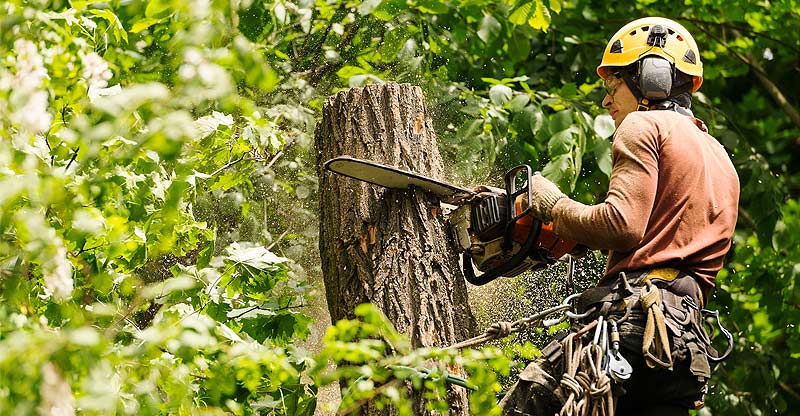
Tree condition assessment determines whether removal makes sense or if other options exist. Professionals examine multiple factors before recommending complete removal versus pruning or treatment. tree removal service technicians use visual inspections, physical tests, and root evaluations to build complete pictures of tree health and stability.
Visual inspection methods
Bark condition reveals internal health problems through visible symptoms. Infected or stressed trees show cracked, peeling, or missing bark. Mushrooms and fungal growth at the base of the tree indicate internal decay. Technicians examine the full trunk circumference for visible damage, discolouration, and texture changes. They also look for scattered dead branches, which can indicate overall structural failure. Structural defects appear in trunk and branch formations. Vertical cracks weaken trees during storms. Co-dominant stems with tight V-shaped unions lack strength. Excessive leaning with exposed or lifting roots shows instability. Technicians measure lean angles to determine whether tilting is recent or part of natural growth patterns.
- Leaf pattern analysis identifies discolouration, premature drop, sparse foliage, and progressive die-back symptoms
- Canopy density assessment evaluates fullness and dead branch distribution throughout crown areas
- Root collar inspection checks for girdling roots, decay, soil level problems, and structural anchoring
- Crown architecture examination looks for weak branch attachments and hazardous overextensions
- Pest and disease identification spots insect damage, blight symptoms, and pathogen entry points
Physical testing techniques
Sounding tests involve tapping trunks with mallets, listening for hollow sounds indicating internal decay. Solid, healthy wood produces sharp, clear sounds. Decayed sections sound dull or hollow, like tapping empty containers. Technicians work around entire circumferences at multiple heights, mapping decay extent. Large hollow areas compromise structural strength even when external appearances seem fine. Resistance drilling uses specialised tools that measure drilling resistance as bits penetrate wood. Consistent resistance indicates solid, healthy wood throughout. Sudden resistance drops signal cavities or decay pockets inside trunks. Graphed resistance patterns show exactly where decay exists and how extensively it spreads through cross-sections. This data quantifies structural integrity beyond surface-level observations.
- Increment borers extract core samples showing growth ring patterns and decay presence
- Penetrometers measure wood hardness, identifying soft rotted sections
- Electronic devices detect moisture levels, indicating potential rot locations
- Strength loss measurements calculate the remaining load-bearing capacity
- Sonic tomography maps internal decay using sound wave transmission
Root system evaluation
Exposed root conditions indicate stability problems requiring immediate attention. Roots lifting above ground surfaces suggest trees tipping from their original positions. Soil mounding on one side, while gaps appear opposite, indicates root plate movement. Damaged or severed major roots caused by construction or trenching result in less anchoring strength and less water and nutrient absorption. Changes in leaves and trunk are important warning signs of root decay because it occurs below the ground. Removing soil around the flare can expose girdling roots that circle the trunk and prevent nutrients from flowing freely. Spading with compressed air clears soil safely and facilitates root collar inspections. Trees with girdling roots gradually weaken over time without visible surface damage.Root system architecture determines wind resistance and drought tolerance beyond what canopy appearance suggests. Fungal indicators at ground level point toward serious root problems. Conks, brackets, or mushrooms growing from root zones signal advanced decay already compromising structural support. These fruiting bodies appear only after extensive decay establishes itself, making them late-stage warnings rather than early detection tools.
Tree removal professionals rely on a systematic evaluation process to determine whether a tree poses a risk or can be preserved. By carefully examining structural stability, signs of disease, root integrity, and environmental factors, they make informed decisions that prioritize safety, property protection, and long-term landscape health.

Comments are closed.